

It’s 9 p.m. You’re stepping over a pallet of candle jars to reach the bathroom. Your garage hasn’t held a car since March, your spouse has started calling it “the warehouse” (not fondly), and a delivery driver just asked whether you run a distribution center. Congratulations: your business is growing. Also, your hallway is full.
Here’s the good news. Small business inventory storage is a solvable problem, and you don’t need to sign a five-year lease on a building the size of an airplane hangar to fix it. This Circle Hub guide walks through your real options, a simple framework for matching stock to space, and the pallet math most articles skip. Grab a tape measure. You’ll want it.
5 Signs You’ve Outgrown the Garage
Not sure it’s time to move? Check yourself against this list.
- Finding stock takes longer than shipping it. If “where did I put the medium ones?” is a regular question, you’re losing money in minutes.
- You’ve oversold or mis-shipped. Cramped storage makes miscounts easy, and customers remember a wrong order longer than a right one.
- Your stacks are getting tall. Boxes piled to the ceiling are an accident waiting to happen, and a pain to dig through.
- Supplier minimums are bigger than your space. If you’re skipping the best price tier because the order won’t fit, your storage is quietly eating your margin.
- You’re paying in time. Take the hours per week you spend moving, counting, or hunting for stock and multiply by what an hour of your time is worth. That’s your hidden rent.
Try this: For one week, jot down every minute spent searching for or shuffling inventory. Total it on Friday. The number tends to be rude, but it gives you a baseline for judging every option below.
Your Small Business Inventory Storage Options, Compared
There’s no universally right answer, only the right fit for your volume, how often you pick products, and where your business is headed. Here are the five realistic options, with honest upsides and catches for each.
Home or Garage

Best for: fewer than about 50 SKUs and low order volume. It’s close, it’s cheap, and you can pack orders in your pajamas.
The catch: Home insurance policies often limit or exclude business inventory, HOA and zoning rules can cap what you store or receive, and freight carriers aren’t thrilled about residential deliveries.
There’s also the matter of your home address showing up on every label and invoice. If you’re staying put for now, a virtual office gives you a professional business address without moving a single box.
Self-Storage Unit
Best for: off-season overflow, backstock, and anything you touch a few times a year.
The catch: Self-storage is built for couches and holiday decorations, not daily order fulfillment. Expect limited access hours, no packing area, and carrying everything by hand. Think of it as a parking spot for your slowest-moving stock, not a place to run your business from.
3PL or Fulfillment Center
Best for: brands with steady, higher volume that want someone else to pick, pack, and ship.
The catch: Onboarding fees, minimum volumes, per-order charges, receiving fees, and less hands-on control over quality. A third-party logistics provider makes sense when your time is worth more than the per-order cost, or when you’re shipping nationwide at scale. If you’re still doing a few dozen orders a day and care how each box looks when it lands, you may be paying for more than you need.
Traditional Industrial Lease
Best for: high, predictable volume and a team that works on-site every day.
The catch: Multi-year terms, deposits, utilities, and extra charges stacked on top of base rent. If sales dip or double, you’re locked in either way. Before you sit down with a broker, it’s worth learning more about how much space a startup actually needs, because brokers earn more when you lease more.
Flexible Warehouse Space (Like Circle Hub’s Northridge Warehouse)
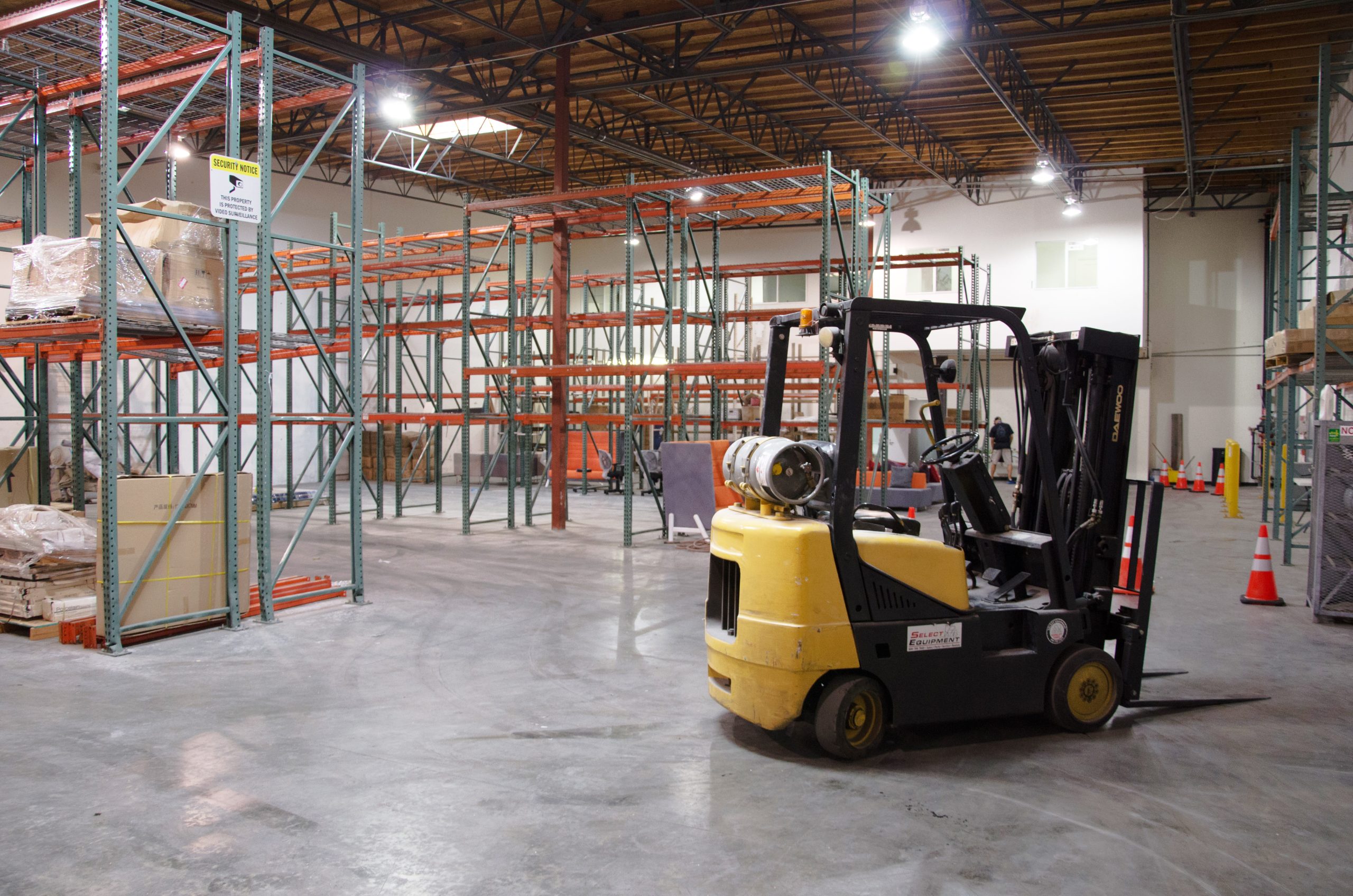
Best for: growing brands that have outgrown the garage but aren’t ready for a dedicated industrial building.
Flexible small business inventory storage fills the gap between “my garage is full” and “I just signed a five-year lease.” At Circle Hub’s Northridge location, you can rent warehouse space by the pallet or by the square foot, with no minimum size and monthly terms. Start with a few pallets, then add more as orders grow. Utilities and Wi-Fi are included, you get 24/7 access to your inventory, and a forklift is available on-site (ask about availability when you tour). That round-the-clock access matters more than it sounds. Nothing stings like a rush order and a locked door at 6 p.m.
The other unusual bit: the warehouse lives in the same building as offices, desks, and meeting rooms. You can pack orders in the morning, then rent a conference room by the hour for a supplier call or client meeting in the afternoon. No commute, and no coffee shop table with a laptop, a spreadsheet, and a prayer. Conference rooms are open to non-members, too.
The catch: You handle your own pick and pack, and it’s a single location in the San Fernando Valley, near the 118, 101, and 405 freeways. That makes it a fit for LA-area businesses, not a nationwide network.
The Access Frequency Test: A Smarter Way to Choose
Most advice says to pick storage based on how much stuff you have. A better question is how often you touch it. Rank every SKU by pick frequency:
- A items: picked weekly or more. These are your bestsellers. Keep them closest to your packing area, in a spot you can reach at any hour.
- B items: picked about once a month. Mid-distance storage is fine.
- C items: picked a few times a year, like seasonal products, bulk reserves, and backstock. These can live in the cheapest, farthest storage you can find.
Most growing brands end up splitting storage by tier instead of cramming everything into one place. A garage or a small warehouse footprint handles your A and B items, while a cheap unit handles C.
Then apply the two-touch rule: if you handle an item more than twice before it ships (unload it, shelve it, move it to the packing table), it’s in the wrong spot. Every extra touch is labor you’re paying for, whether or not it shows up on an invoice.
Do the Pallet Math Before You Shop
Right-sizing your small business inventory storage takes about twenty minutes and a tape measure. Skip it and you’ll either overpay for empty air or run out of room by November.
- Measure cases, not products. Take your top 10 SKUs and record the dimensions of the shipping case, since that’s what actually takes up space.
- Calculate cubic feet. Multiply case length × width × height (in inches), divide by 1,728, then multiply by the number of cases.
- Convert to pallet positions. A standard pallet is 48″ × 40″. Decide your safe stacking height up front, and don’t guess.
- Add 20–25%. Growth, aisle space, and the inevitable “we ordered extra” all need breathing room.
- Size for your peak. Plan for your Q4 rush, not your average month, then check whether flexible terms let you shrink back afterward.
Pro tip: Providers price by the pallet, the square foot, or the cubic foot, and none of those compare directly. Convert every quote to cost per pallet position per month so you’re comparing apples to apples. A spreadsheet with four columns will do the job.
The Hidden Costs Nobody Puts in the Quote

The sticker price of small business inventory storage is rarely the real price. Watch for these:
- Receiving and handling fees, especially at 3PLs.
- Insurance gaps. Ask your insurer whether your current policy covers inventory stored off-site or at home.
- Lease extras: utilities, common-area charges, deposits, and build-out costs.
- Access limits. Business-hours-only access can delay a rush order.
- Equipment. Forklifts, pallet jacks, and packing tables add up fast if they aren’t included.
- Opportunity cost. Cash sitting in overstock isn’t working for you.
Ask every provider for an all-in monthly number in writing, covering everything you’ll realistically use. If they can’t give you one, that tells you something too.
Build a Hybrid Setup for Seasonal Spikes
It’s mid-October, which means Q4 is no longer “coming up.” It’s here. For many brands, the smartest move is a hybrid: keep a small core footprint for your A items year-round, add flexible space for holiday volume and bulk buys, and release it in January.
This is where monthly terms earn their keep. Committing to a year of space you’ll only fill for six weeks is how storage budgets quietly bleed. Also think about the people side. Seasonal helpers need somewhere to work, and a designated desk or hot spot covers laptops and order management without leasing an entire office.
Mini checklist before peak season:
- Check supplier lead times, then add a week.
- Confirm minimum order quantities.
- Set a last-day-to-reorder date.
- Decide in advance when you’ll release the extra space.
A 7-Point Checklist for Vetting Any Storage Space
Screenshot this before you tour anywhere:
- Can you get in after hours and on weekends?
- Is there a loading dock or forklift, or is everything carry-it-yourself?
- Is the space clean, dry, and secure?
- Are utilities and internet included?
- Can you scale up or down without penalties?
- Is there a place to pack and label orders?
- Is there somewhere to meet a supplier or take a call?
If a place fails more than two, keep looking. Your inventory deserves better, and so do you.
FAQ
How much does warehouse space cost per pallet per month?
Pricing varies by market, building, and what’s included, so don’t compare headline rates. Ask for an all-in monthly price covering utilities, handling, and access, then compare the cost per pallet position.
Can I legally store business inventory at home?
Often yes, but check local zoning, HOA rules, and your insurance policy. Larger volumes, frequent deliveries, or equipment like forklifts can trigger restrictions.
What should I do with slow-moving inventory that’s eating my space?
Move it to your C tier, discount or bundle it, and relocate whatever’s left to your cheapest storage. Don’t pay premium rent on stock that isn’t selling.
Conclusion: Let Your Storage Grow With You
The right small business inventory storage setup should grow when you do and shrink when you don’t. Match storage to how often you touch your stock, do the pallet math, and avoid committing for longer than you need to.
If you’d like to see what flexible warehouse space looks like in person, book a no-obligation tour of Circle Hub today.