

Let’s do some quick math. You need an actual office about six days a month. A traditional lease needs you about thirty. Somewhere, an empty ergonomic chair is quietly judging your cash flow.
The good news: you don’t have to choose between a kitchen table that doubles as a laundry-folding station and a multi-year commitment. Part time office rental has become a legitimate middle path, and the options are broader than most people realize.
It’s also not a niche preference. Gallup’s tracking shows that as of August 2026, 54% of remote-capable U.S. employees work in a hybrid arrangement, and roughly six in ten say hybrid is what they’d choose if it were up to them. Most of us are splitting our time between home and “somewhere else,” and the workspace market has finally caught up.
Below, Circle Hub has rounded up six flexible workspace options, plus a simple two-week method for figuring out which one fits your actual schedule instead of your optimistic one.
Option 1: The Drop-In Hot Spot
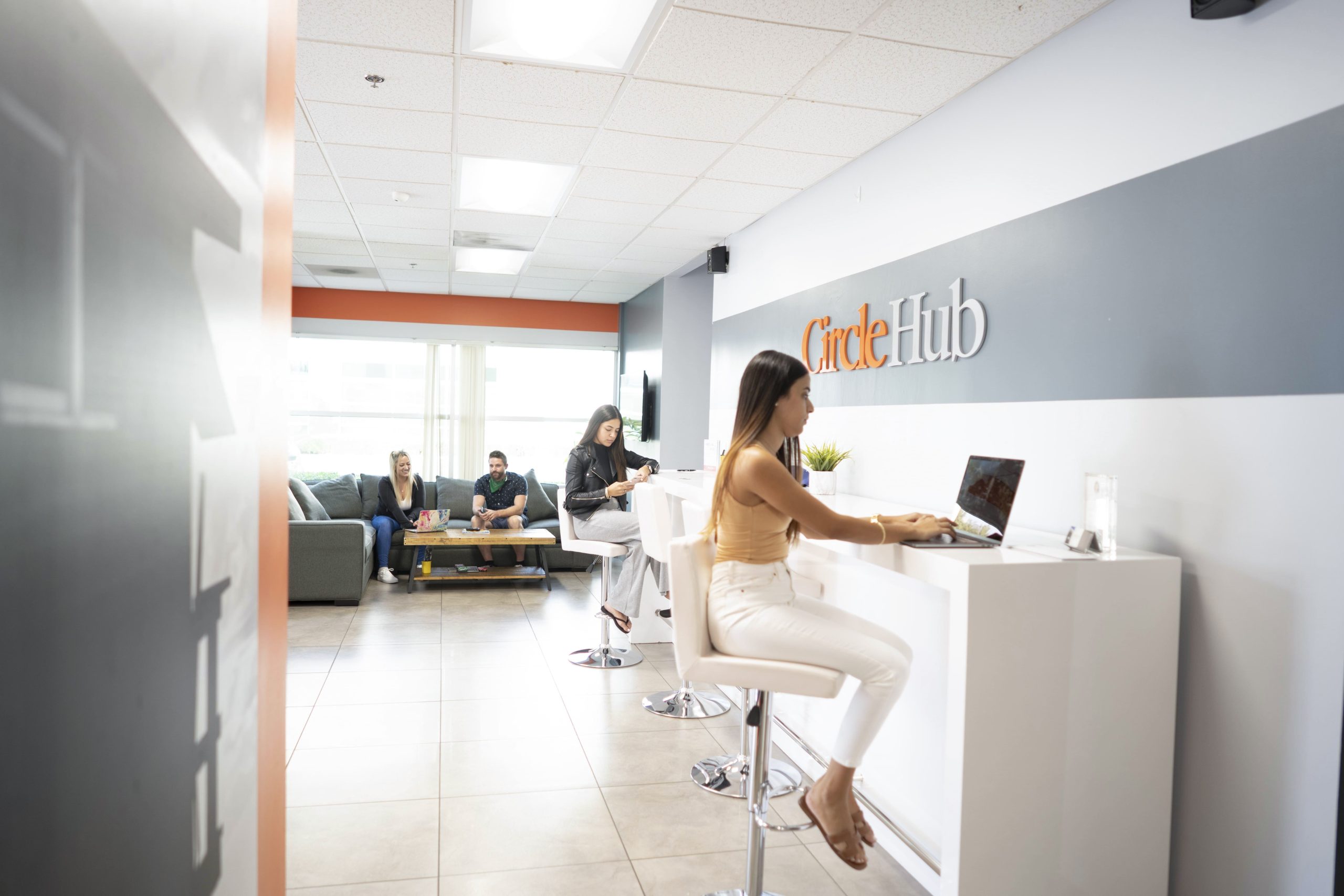
Best for: freelancers, consultants, and anyone whose in-person days are hard to predict.
A hot spot is the no-strings option. You walk in, grab a seat at a work bar or lounge area, and get to work. At Circle Hub, Hot Spots mean you drop by when you want, use the shared community spaces, and get high-speed internet and complimentary beverages, with no long-term commitment.
The tradeoff is obvious: no permanent desk and no door. You’ll hear the occasional laugh too.
Make it work: Use a hot spot for what we’ll call “reset days.” You know the ones. Home has gone stale, you’ve reorganized the pantry twice, and it’s only 10 a.m. A change of scenery plus a room full of people quietly working makes procrastination feel awkward, which is a feature, not a bug. Set a two-hour block, silence your notifications, and tackle your hardest task in the first 20 minutes while the novelty is still working in your favor.
A bonus most people overlook: a shared space is also a low-pressure way to meet other local business owners and practice your micro-networking skills.
Option 2: The Designated Desk
Best for: people who go in two to four days a week and are tired of rebuilding their setup every time.
A designated desk is your own personal desk in a shared area, exclusively yours. Nobody else can sit there. Your stapler finally gets a permanent address, and your lucky mug can stop living out of a tote bag. Check out the details on the Designated Desks section of our workspaces page.
Make it work: The real value of a designated desk isn’t the furniture. It’s the reduction in decisions. Keep a small “go bag” at the desk (a spare charger, a headset, a notebook, a pen you actually like), then build a 60-second arrival ritual: connect to Wi-Fi, open your calendar, write your top three tasks. The fewer choices you make at 9 a.m., the faster you get into real work.
Who it’s not for: If you take sensitive calls all day, you’ll want walls. Keep reading.
Option 3: The Private Office on Flexible Terms
Best for: anyone who needs a door that locks, whether that’s client confidentiality, back-to-back calls, or a small team of one to five people.
Of all the options here, this is the heavy-duty version of part time office rental. You get walls, a lock, and a space that’s entirely yours, without signing away five years of your life. Circle Hub’s private offices come furnished and move-in ready, with high-speed Wi-Fi, 24/7 access, an onsite community manager, printing, cleaning services, and access to shared lounges and conference rooms. Terms are flexible, with no long-term commitment.
Make it work: Before you sign anything, anywhere, ask how easy it is to move up or down in size mid-term. That’s where “flexible” deals tend to get a lot less flexible. If you and a colleague work alternating days, ask about desk counts too. A suite sized for two people who rarely overlap can beat paying for two separate setups, and your shared calendar becomes the world’s most boring roommate agreement.
Option 4: Conference Rooms by the Hour
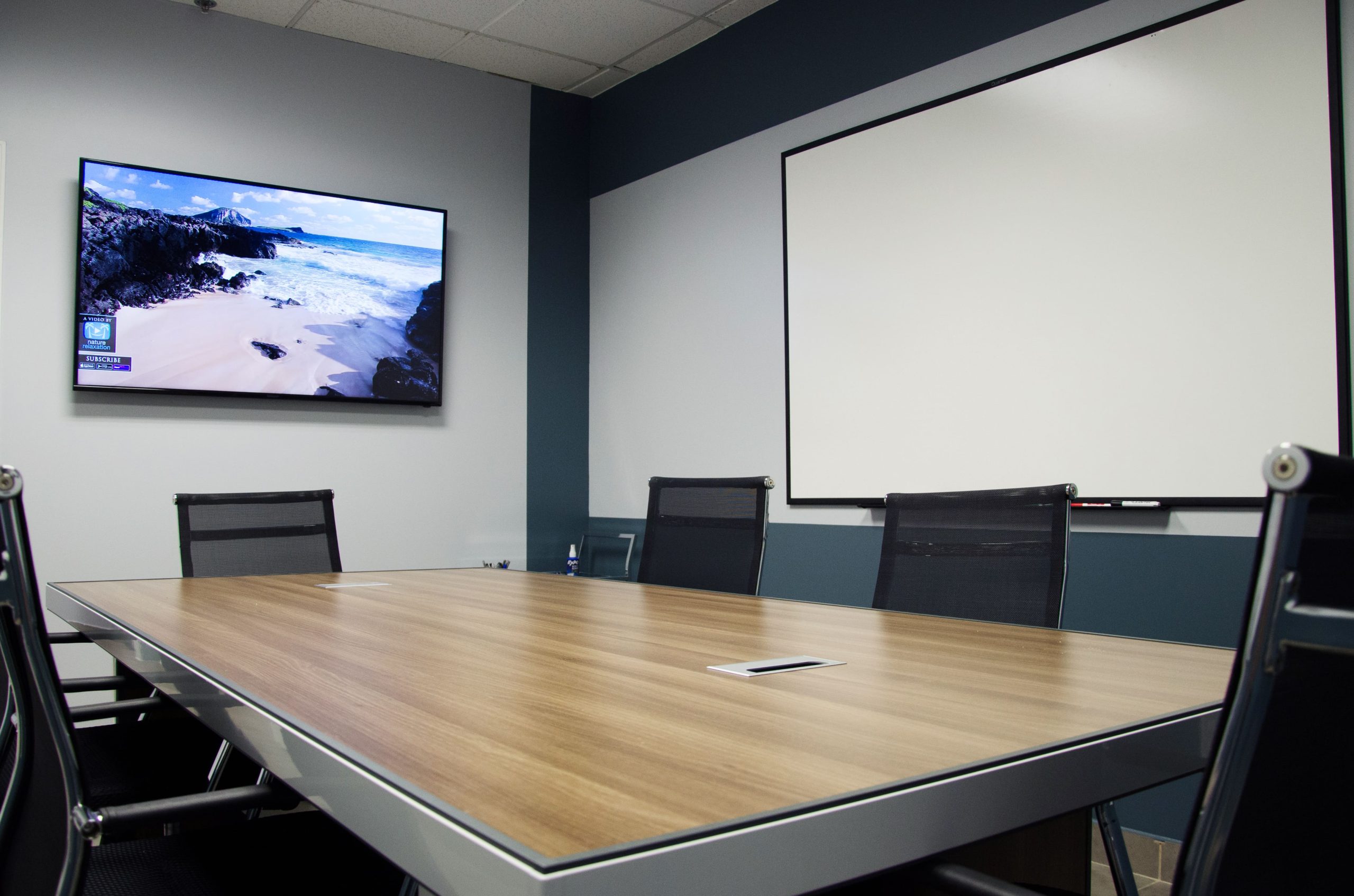
Best for: people who happily work from home but need a professional setting for client pitches, interviews, or team workshops.
Here’s a truth about working from your living room: the work is fine, but the “meeting a new client” part is not. Circle Hub’s conference rooms are available by the hour, in multiple sizes for four to sixteen people, and each one comes with a whiteboard and a flat-screen TV. That’s a boardroom experience at a fraction of what a permanent boardroom costs.
Make it work: Book the room 15 minutes before and 15 minutes after your meeting. Use the “before” window to test the screen and arrange your notes, and the “after” window to write down action items while everyone’s promises are still fresh. Send your guests clear arrival instructions in advance, including where to park and which door to use. Nothing undermines a polished first impression like a client circling the lot on a 10-minute countdown.
Option 5: Day-Use Hotel Rooms
Best for: occasional heads-down days, writing deadlines, and marathons of video calls.
Many hotels rent out rooms during the day, when they’d otherwise sit empty. You get a desk, a door, a bathroom, and zero small talk with coworkers about whose yogurt that is. Booking platforms like Dayuse and HotelsByDay list these day rates in many cities, and it never hurts to call a hotel directly and ask whether they offer one.
Watch-outs: Some rooms are designed for sleeping, not typing, and a bed is a terrible ergonomic choice for eight hours of spreadsheets. Before you book, ask about the desk setup, outlet access, and Wi-Fi speed, and check the check-in and check-out windows so you don’t get evicted mid-presentation. Also, skip the idea of hosting clients here. Welcoming someone into a bedroom for a business pitch is a vibe nobody needs.
Pro move: If you only need a few hours, an upscale hotel lobby lounge with solid Wi-Fi and a decent latte is often a perfectly civilized place to answer email. Just don’t take confidential calls there.
Option 6: Your Public Library (Yes, Really)
Best for: deep focus, tight budgets, and anyone who thinks the quietest option is the best one.
Public libraries are one of the most underrated workspaces in America. They’re typically free, they’re quiet, and the Wi-Fi is usually dependable. Many branches also offer study rooms or small meeting rooms you can reserve, though policies vary widely by location, so check what your local branch allows, including time limits and whether you need a library card.
Watch-outs: Hours can be limited, outlets can be scarce, and phone calls are usually a hard no outside designated rooms. Treat it as a place for writing, research, and planning, not for client calls. Keep your screen angled away from the public too, especially if you’re handling anything sensitive.
Make it work: Call ahead and find out which branch has bookable rooms, then reserve them as early as the policy allows. Bring headphones, a charger, and a water bottle, and plan your library days around work that needs silence. It makes a great partner to a louder option, like a hot spot, on the days you need to make noise instead of avoid it.
How to Pick: The Two-Week Office Diary

Before you commit to any part time office rental, spend two weeks gathering data about yourself.
Step 1: Keep the diary. For 10 working days, jot down where you worked, why you needed a space that day, and what you wished you had. Be specific. “Needed a door” tells you something different than “needed people.”
Step 2: Run the Four-Need Test. Look at your notes and score how often each need shows up:
- A door (privacy, calls, confidential work) points you toward a private office.
- A room (whiteboard, screen, space to host others) points you toward an hourly conference room.
- A crowd (energy, community, accountability) points you toward a hot spot or designated desk.
- Quiet and cheap (focus without frills) points you toward a library or a day-use hotel room.
Step 3: Do the cost-per-use math. Divide the monthly price of a space by the number of days you’ll truly use it. Here’s a hypothetical: a $300-a-month option you use six days costs $50 per visit. Use it twelve days, and it drops to $25. Plug in real quotes and your real diary numbers, and the best choice often stops being a mystery.
As a rough rule of thumb (not a guarantee), if your diary shows fewer than about eight in-person days a month, a lighter part time office rental option usually beats a full private suite. If you’re regularly past twelve or more, the private office starts to look much smarter.
Step 4: Stack your options. You don’t have to pick just one. A few combinations that work well:
- The solo consultant: library for writing days, hourly conference room for client meetings.
- The product seller: designated desk for admin work, plus warehouse space for inventory.
- The two-person startup: a shared private office with alternating schedules.
Bonus tip: cluster your days. If you can, stack your in-person days together, say Tuesday through Thursday, so meetings, client visits, and collaboration all land in the same window. It also makes your calendar easier to defend when someone asks, “Can we meet Monday?”
Re-run the diary every quarter. Your business changes, and your workspace should keep up with it.
Questions to Ask Before You Commit
Whether you’re touring a coworking space or calling a hotel, a few smart questions can save you a headache:
- Who can I bring in? Ask about guest policies and whether visitors need to be registered.
- What’s the notice period? Find out how much warning you need to give if your plans change.
- How do upgrades and downgrades work? Flexibility is only flexible if you can actually use it.
- What’s included, and what’s extra? Printing, conference room hours, and beverages can vary a lot.
- When can I get in? Check access hours, since some spaces, like Circle Hub, are open 24/7, and others aren’t.
- Can I see it at the time I’d actually work? Tour on a Tuesday afternoon, not on a quiet Friday morning. You want the true sound level, not the brochure version.
Frequently Asked Questions
How much does part time office rental cost?
It depends on your city, the type of space, and how often you use it. Generally, library rooms and drop-in seating sit at the low end, while private offices land at the high end. Skip the guesswork: collect current quotes and run the cost-per-use math from the diary section.
What’s the difference between coworking and a serviced office?
Coworking is shared space with flexible seating, usually in a community setting. A serviced office is a private, furnished room with utilities and amenities bundled in, so you can move in without buying a single desk.
Is a coworking membership tax deductible?
Often, workspace costs can be treated as a business expense, but the rules depend on your situation and structure. Ask your CPA or tax professional before you count on it.
The Bottom Line: Right-Size Your Workspace
Part time office rental isn’t a downgrade from “real” office life. It’s right-sizing. You pay for the space, privacy, and community you’ll actually use, and you stop funding that empty ergonomic chair. Whether you land on a library table, a hotel desk, a hot spot, or a private office with a door that locks, the smartest move is to match the space to your real calendar.
If you’d like to see how these options feel in person, book a free tour of Circle Hub’s Northridge space. Wander through the hot spots, peek into the conference rooms, and picture your stapler in its new home.